Skip to content
 Bad Breath: What Causes It and When to See a Dentist

In most people, bad breath comes from the mouth itself, not the stomach. Bacteria living on the tongue, between the teeth and under the gums break down bits of food and dead cells, and release gases that smell. Fix where those bacteria live and the smell usually goes.
Mouthwash and mints only cover it up for an hour or so. Here’s how to find the real cause.
Is it really bad breath?
It’s surprisingly hard to judge your own breath. Your nose gets used to your own smell. Breathing into your hand doesn’t work well either.
Two better tests:
- Lick the inside of your wrist, let it dry for ten seconds, then smell it. That’s roughly what your saliva smells like.
- Gently scrape the back of your tongue with a spoon and smell what comes off. That’s the area most bad breath comes from.
Or ask someone you trust. It’s an awkward question, but a better answer than guessing.
The common causes
A coated tongue. The back of the tongue is rough, and bacteria collect in the grooves. This is the single most common source. If your tongue looks white or yellow at the back, start here.
Gum disease. Bacteria under inflamed gums produce some of the strongest-smelling gases. If your gums bleed when you brush, or you have a bad taste that keeps coming back, gum disease is likely part of it. Our guide to bleeding gums explains how to tell how far it’s gone.
Food trapped between teeth. Particularly where teeth are crowded, under a bridge, or around an old filling with a gap at the edge.
Dry mouth. Saliva washes bacteria away. Anything that dries your mouth makes breath worse: sleeping with your mouth open, not drinking enough water, long gaps between meals, and many common medicines. That’s why breath is usually worst first thing in the morning.
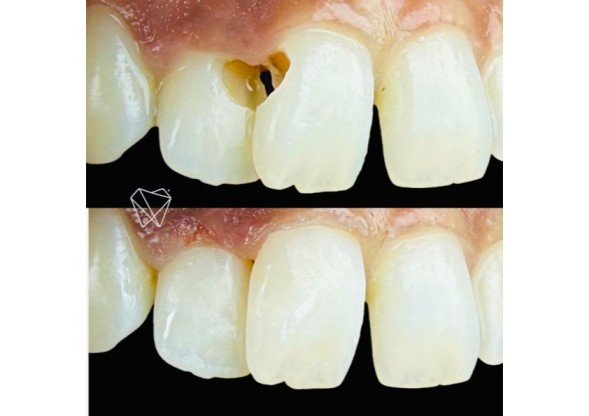
Decay and old dental work. A cavity or a broken filling can trap food and bacteria where a brush can’t reach.
Smoking and tobacco. Smoking dries the mouth and damages the gums, on top of the smell of the tobacco itself.
Certain foods. Garlic and onion are absorbed into the blood and breathed out through the lungs. No amount of brushing fixes that, but it passes within a day.
When it isn’t your mouth
Less often, bad breath comes from somewhere else: sinus infections and post-nasal drip, tonsil stones, acid reflux, or medical conditions such as poorly controlled diabetes. If your teeth, gums and tongue are healthy and the smell continues, we’ll tell you so and suggest seeing your doctor or an ENT specialist.
What you can do at home
Try this properly for two weeks:
- Clean your tongue every morning. A tongue scraper works better than a toothbrush. Start at the back and pull forward, gently, three or four times.
- Clean between your teeth once a day with floss or interdental brushes. A toothbrush can’t reach between teeth, and that’s where trapped food sits.
- Brush twice a day for two minutes, including along the gumline.
- Drink water through the day, especially if you talk a lot for work or drink a lot of tea and coffee.
- Clean anything removable. Dentures, retainers and night guards collect bacteria too.
If it’s better after two weeks, keep going. If it isn’t, see a dentist.
When to see a dentist
Come in if:
- the bad breath hasn’t improved after two weeks of good cleaning
- your gums bleed, look swollen, or have pulled back from your teeth
- you have a bad taste in your mouth that keeps returning
- a tooth feels loose, or food keeps packing into the same spot
- someone close to you has mentioned it more than once
What we do at the clinic
We start by finding the source. We check your gums, measure the gaps between gums and teeth, look for decay, broken fillings and food traps, and look at your tongue.
If gum disease is the cause, a professional cleaning removes the tartar that home brushing can’t. For deeper problems, scaling and root planing cleans the root surfaces under the gums. We also use laser-assisted gum therapy. Details are on our gum treatment page. If the problem is a broken filling or a cavity, fixing it removes the trap.
Common questions
Does mouthwash cure bad breath? No. Most mouthwashes mask the smell for a short time. Some alcohol-based ones dry your mouth and can make it worse later.
Why is my breath bad even though I brush twice a day? Usually because the tongue and the spaces between the teeth are being missed. Those two areas cause most bad breath.
Is bad breath a sign of a stomach problem? Occasionally, but far less often than people assume. It’s worth ruling out the mouth first, because that’s where the cause is in most cases.
Can children have bad breath? Yes, often from mouth breathing, a coated tongue or enlarged tonsils. It’s worth mentioning at their next dental check-up.
Book a check-up
Bad breath is one of the most common things people feel embarrassed to bring up. You don’t need to be. It’s usually simple to find and fix.
House of Tooth, Lane No. 4, behind Balewadi High Street, Baner, Pune 411045. Open Monday to Saturday 10 am – 8 pm, Sunday 10 am – 7 pm. Call or WhatsApp +91 70196 02137, or book online.
About the author. Dr. Aniket Kasodekar is BDS, MDS with a Fellowship in Lasers, and leads House of Tooth in Baner, Pune. He treats gum disease with laser-assisted periodontal therapy.
This article is general information, not a diagnosis. If you’re worried about your breath or your gums, book an examination.