Skip to content
 Do You Need a Crown After a Root Canal? When It Matters and Why
For a back tooth, you’ll usually need a crown after root canal treatment. For a front tooth, often you won’t. The root canal saves the tooth by removing the infection inside it. The crown protects what’s left of the tooth so it doesn’t crack later. Skipping the crown is one of the most common reasons a tooth the dentist saved is lost a year or two down the line.
Here’s how we decide, and why it matters so much for some teeth and not others.
Why a root canal treated tooth gets weaker
Most of a tooth’s strength comes from its outer walls and the ridges on top. By the time a tooth needs a root canal, a lot of that has usually gone already: a large cavity, an old filling that’s broken down, or a crack that let bacteria in.
The treatment itself then removes more. To reach the canals, the dentist has to make an opening through the top of the tooth. What remains can be a hollow shell with thin walls.
There’s a second change too. A tooth with a living nerve can sense when you’re biting too hard and you ease off without thinking. After a root canal, that warning is gone. People often chew harder on a treated tooth than they realise.
Put those together and you get the typical story: the tooth feels fine for months, then one day you bite on something hard and it splits. If the crack runs down into the root, the tooth usually can’t be saved.
When you need a crown after root canal treatment
Molars and premolars almost always need one. Back teeth take most of the force when you chew. A crown covers the whole top of the tooth and holds the walls together, so biting forces spread across the tooth instead of wedging it apart.
Any tooth that’s lost a lot of structure needs one. If more than about half the tooth is gone, a filling has too little to hold onto, whichever tooth it is.
Teeth that are already cracked need one. A crown can hold a cracked tooth together and stop the crack from spreading.
When a filling may be enough
Front teeth with small access holes. Incisors and canines mostly bite and tear rather than grind. If the tooth was otherwise healthy and the only damage is the small opening the dentist made, a well-bonded filling is often all it needs.
Some back teeth in specific cases. If a premolar has strong walls left and you don’t grind your teeth, a bonded restoration that covers the biting edges (an onlay) can be an option. This is a case-by-case call, and we’ll tell you if your tooth qualifies.
| Situation | Usually needs |
|---|---|
| Molar after root canal | Crown |
| Premolar after root canal | Crown, sometimes an onlay |
| Front tooth, little damage | Filling |
| Front tooth, large old fillings or a crack | Crown |
| Any tooth that’s lost more than half its structure | Crown, sometimes with a post first |
What’s a post, and do you need one?
If so little of the tooth is left that there’s nothing for a crown to grip, the dentist may place a post. It sits a short way into one of the treated canals and helps hold a core of filling material, which the crown then fits over.
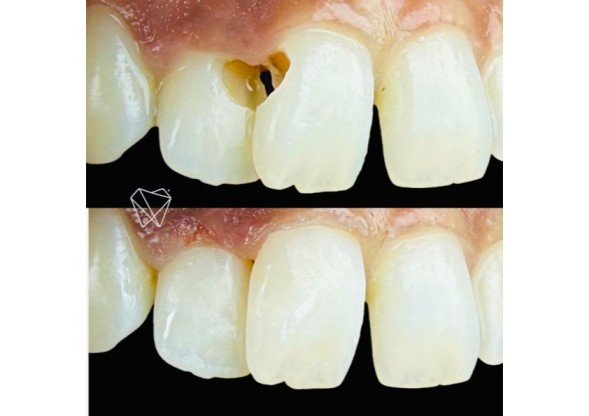
Posts don’t make a tooth stronger by themselves. They’re only there to give the crown something to hold. Plenty of teeth don’t need one. You can see a real example of a badly broken tooth rebuilt with a root canal, post and ceramic crown in our fractured tooth case study.
How long can you wait between the root canal and the crown?
Not long. Aim for a few weeks, not months.
After the root canal you’ll usually have a temporary filling. It’s designed to last a short time. As it wears, bacteria can leak back into the tooth and undo the treatment. And until the crown goes on, the tooth is at its weakest.
Until we fit your crown:
- Chew on the other side as much as you can.
- Avoid hard foods on that tooth: nuts, hard sweets, ice, chikki, bones.
- Come back if the temporary filling feels rough, loose or falls out.
What getting a crown involves
- Shaping the tooth. We reshape the tooth slightly so the crown can fit over it. Because the root canal has already treated the nerve, this usually needs little or no numbing.
- Scanning. At House of Tooth we take a 3D digital scan with an iTero scanner instead of a mould.
- A temporary crown protects the tooth while the final one is made.
- Fitting the final crown, checking the bite, and cementing it in place.
Crowns come in different materials. Full ceramic crowns, such as Emax, look natural and are strong enough for most teeth. We’ll recommend one based on where the tooth is and how hard you bite. More detail is on our crowns and bridges page.
Common questions
My tooth feels fine after the root canal. Do I still need the crown? Yes, if your dentist recommended one. Feeling fine is normal. The risk isn’t pain, it’s a sudden fracture.
Is it better to just pull the tooth? Usually not. Keeping your own tooth is generally the better option when we can save it and protect it properly. Our post on root canal vs extraction goes through how to decide.
Does getting a crown hurt? Most people find it much easier than the root canal. If you’re nervous about treatment in general, this explainer on root canal pain covers what you’ll actually feel.
How long does a crown last? With good cleaning and regular check-ups, many crowns last a decade or more. Grinding your teeth and skipping check-ups shortens that.
Book your crown
If you’ve had a root canal and haven’t had the tooth crowned yet, don’t leave it. Come in and we’ll check the tooth and the temporary filling, and tell you what it needs.
House of Tooth, Lane No. 4, behind Balewadi High Street, Baner, Pune 411045. Open Monday to Saturday 10 am – 8 pm, Sunday 10 am – 7 pm. Call or WhatsApp +91 70196 02137, or book online. Read more about root canal treatment at House of Tooth.
About the author. Dr. Aniket Kasodekar is BDS, MDS with a Fellowship in Lasers, and leads House of Tooth in Baner, Pune.