Skip to content
Toothache at Night: Why It Gets Worse and How to Get Some Sleep

A toothache at night often feels worse because lying down sends more blood towards your head, which raises the pressure inside an already inflamed tooth. Keeping your head raised, a cold pack and a safe painkiller can help you get through the night. However, tooth pain that wakes you up usually means the tooth needs a dentist soon.
It is a familiar story: the tooth was fine during the day, and then at 2 am it starts to throb. Here is why it happens, what you can do tonight, and how to tell when it can’t wait.
Woken up by tooth pain? WhatsApp us on +91 70196 02137 any time. We open at 10 am every day, including Sunday.
Why does a toothache get worse at night?
- Lying flat. More blood flows to your head when you lie down. As a result, the pressure on the inflamed nerve inside the tooth goes up, and the throbbing gets stronger.
- Fewer distractions. During the day, work and conversation take your mind off the pain. At night, in a quiet room, you notice every throb.
- Grinding or clenching. Many people grind their teeth in their sleep, which puts extra force on a sore or cracked tooth.
- Food left in place. A late dinner or sweet chai before bed can leave food packed around a cavity or under the gum.
What usually causes it
| Cause | What you may notice |
|---|---|
| A deep cavity reaching the nerve | Throbbing pain, worse with hot, cold or sweet, lasting after the trigger is gone |
| An infection at the root (abscess) | Constant pain, pain when biting, sometimes swelling or a bad taste |
| A cracked tooth | Sharp pain when biting or releasing, sometimes with cold |
| A wisdom tooth coming through | Pain and swelling at the very back of the mouth |
| Gum infection or trapped food | Sore, swollen gum around one tooth |
| Sinus congestion | Dull ache in several upper back teeth, often with a cold |
Sensitivity that lasts only a second or two with cold food is different, and usually less urgent. Read why does my tooth hurt with cold food?
How to ease a toothache at night
These steps can help until you see a dentist:
- Raise your head. Sleep with an extra pillow so your head is higher than your heart.
- Use a cold pack on your cheek, in 20-minute spells, with a cloth between the ice and your skin.
- Rinse with warm salt water to clean the area gently.
- Floss gently around the tooth to remove any trapped food.
- Take a painkiller that is safe for you, as advised by your doctor or pharmacist. Take it as directed, not more.
- Avoid very hot, cold or sweet food and drinks before bed, and chew on the other side.
What not to do:
- Don’t put a tablet on the gum next to the tooth. It can burn the gum.
- Don’t apply heat to your cheek if there is swelling, because it can make an infection spread.
- Don’t overuse clove oil. A little on cotton may numb the area briefly, but too much can irritate the gum. It doesn’t treat the cause.
- Don’t keep taking antibiotics left over from an earlier illness. They aren’t a fix for a toothache, and the tooth still needs treatment.
Is it an emergency?
| Go to a hospital straight away | WhatsApp or call us as soon as we open |
|---|---|
| Swelling spreading towards the eye or neck | Pain that wakes you up or keeps you awake |
| Fever with facial swelling | Swelling of the gum or cheek |
| Difficulty swallowing or breathing | Pain when biting, or a bad taste |
| Heavy bleeding that won’t stop | A broken tooth or a lost filling or crown |
Our dental emergency guide explains what to do in each situation.
Why you shouldn’t wait for the pain to go away
Sometimes the pain stops on its own after a few days. Unfortunately, that can mean the nerve inside the tooth has died, not that the problem has healed. The infection can then spread quietly into the bone, and it often comes back as a swelling. Treating the tooth early usually means a simpler treatment.
How we treat a toothache
First, we examine the tooth and take a digital X-ray to find the cause. After that, the treatment depends on what we find:
- A cavity: a filling, often done in one visit.
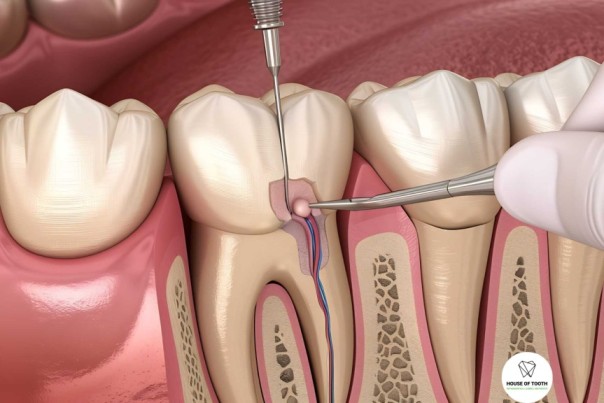
- An inflamed or infected nerve: root canal treatment, which removes the infection and saves your tooth. It is done under local anaesthesia. Read is a root canal painful? Afterwards, a back tooth usually needs a crown; see do you need a crown after a root canal?
- A wisdom tooth: a check of its position, and removal if needed. See wisdom tooth pain.
- A gum problem: cleaning and gum treatment.
Wherever suitable, we use laser-assisted techniques to make treatment more comfortable.
Book an appointment for tooth pain
Don’t spend another night with tooth pain. Our online calendar shows same-day times when they are free, and you can also WhatsApp or call us.
House of Tooth, Lane No. 4, behind Balewadi High Street, Baner, Pune 411045. Open Monday to Saturday 10 am – 8 pm, Sunday 10 am – 7 pm. Call or WhatsApp us on +91 70196 02137, or book online. See root canal treatment at House of Tooth.
About the author. Dr. Aniket Kasodekar is BDS, MDS with a Fellowship in Lasers, and leads House of Tooth in Baner, Pune.