Skip to content
 When Should My Child First See an Orthodontist? Age 7, and Why It Matters
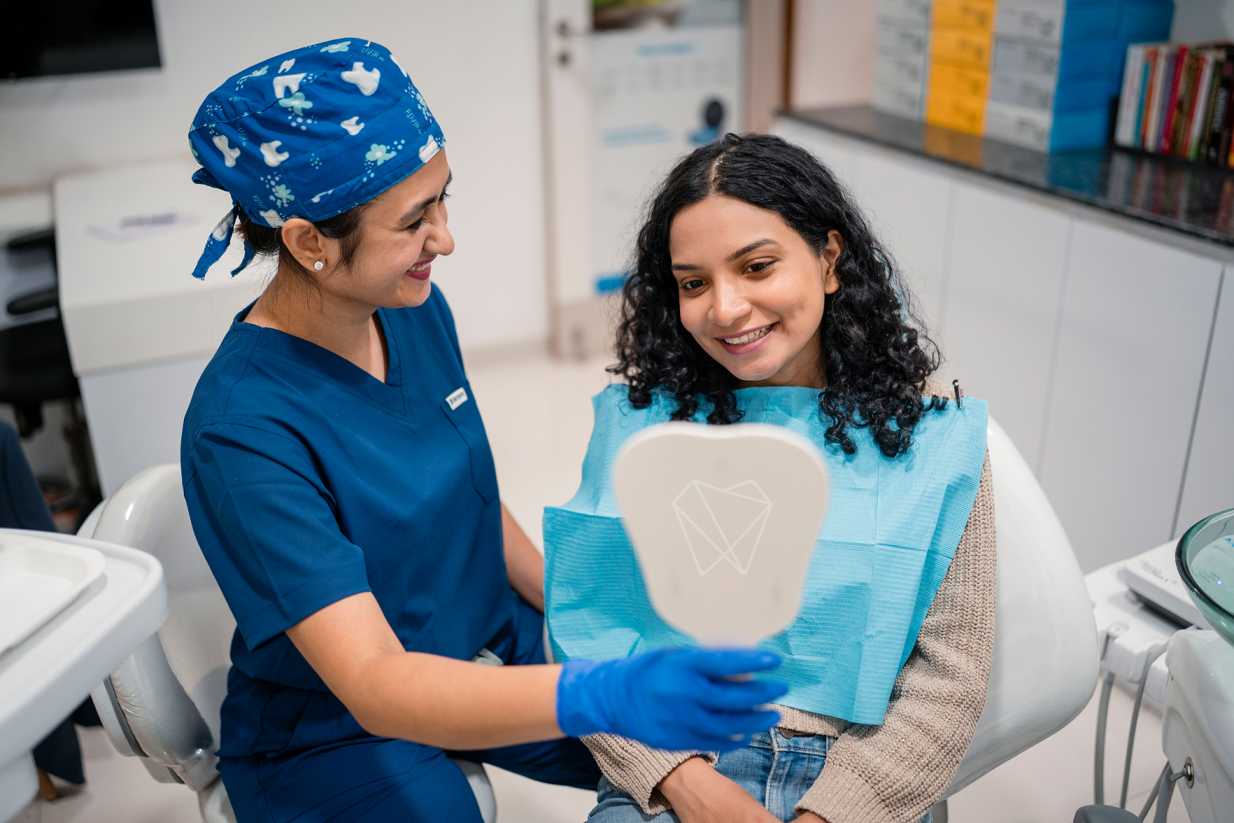
When should my child see an orthodontist? Take them for a first check at age 7. Most children examined at 7 need no treatment at all — and that is a useful result, not a wasted visit. The reason for the age is that a small number of problems only respond while the jaw is still growing, and by the time all the permanent teeth have arrived, that window has closed.
The American Association of Orthodontists recommends screening every child by 7. This is the single most useful piece of orthodontic advice most parents never receive.
When should my child see an orthodontist? Why age 7
By around seven, the first permanent molars and the permanent front teeth have usually come through. That is the earliest point at which an orthodontist can see how the bite is establishing itself — the relationship between the upper and lower jaws, not just whether the teeth look crooked.
Before 7 there is too little permanent dentition to judge. Much after 7, and some of the useful options start to disappear.
What we are looking for
Most of it is invisible to parents, which is exactly why the visit matters.
- Crossbite — upper teeth biting inside the lower ones, which can push the jaw to one side as it grows
- Severe crowding — where there is clearly not enough room for the teeth still to come
- Protruding upper front teeth — significantly more likely to break in a fall or while playing sport
- Reverse bite, where the lower jaw sits ahead of the upper
- Open bite — front teeth not meeting, often related to thumb sucking or tongue habits
- Missing or extra teeth, visible on an X-ray long before they would be noticed otherwise
- Baby teeth lost much too early or retained much too late
- Breathing and habit patterns — persistent mouth breathing, thumb sucking past about age 5
The part that is genuinely time-limited
This is the reason the age-7 recommendation exists, and it is worth understanding properly.
Widening a narrow upper jaw. The upper jaw has two halves, joined by a suture along the palate. While that suture is still open, an expander can widen it gently — an orthopaedic change to the bone itself. Once it fuses, around puberty, widening the jaw the same way is no longer possible and correction becomes surgical.
Correcting a lower jaw that sits ahead of the upper. Where the upper jaw is underdeveloped, protraction — often with a face mask — can encourage it forward. This works best well before age 10 and becomes markedly less effective afterwards.
Guiding a jaw discrepancy during the growth spurt. Where the lower jaw is set back, functional appliances used around the pubertal growth spurt can influence how it grows. Miss the spurt and the same problem in an adult usually needs camouflage or surgery.
We have documented one of these cases: upper jaw expansion with face mask therapy for reverse overjet, treated at age 11.
None of this applies to most children. But you cannot know whether it applies to yours without somebody looking.
What actually happens after the visit
There are only three outcomes, and the first is the most common.
1. Monitoring. No treatment now. We see your child periodically as the permanent teeth arrive, and act only if and when something needs acting on. For most seven-year-olds this is the answer.
2. Early interceptive treatment, roughly ages 7–10. A short, targeted phase addressing one specific problem — an expander for a narrow jaw, space maintenance after an early tooth loss, or habit correction. It is not a full set of braces and is not about straightening everything.
3. Full treatment, usually ages 11–14. Braces or aligners once most permanent teeth are present. This is what most people picture when they think of orthodontics, and it is when the majority of treatment happens.
A clinic that recommends full braces for a seven-year-old with no skeletal problem is doing something we would question. Be willing to ask why, and to seek a second opinion.
Common questions Indian parents ask us
“Shouldn’t we wait until all the permanent teeth are in?” For most children, yes — and we will tell you to. But that is a decision to be made after an examination, not instead of one. Waiting by default is precisely how skeletal windows get missed.
“Will early treatment mean braces twice?” Sometimes. Interceptive treatment at 8 does not always remove the need for braces at 12. What it does is make the second phase simpler, shorter, and in some cases avoid surgery altogether.
“My child’s baby teeth are crooked — is that a problem?” Often not. Crowded baby teeth often still give way to well-aligned permanent ones, and gappy baby teeth are usually a good sign, as the gaps make room for larger permanent teeth.
“My child is scared of dentists.” Then start earlier and easier. A first visit with nothing done except looking and counting is the best possible introduction. We treat children regularly and the first appointment is deliberately uneventful — see our child dentistry case and our paediatric dentistry page.
Braces or aligners for children?
Both work. Aligners such as Invisalign First are made for growing children and can incorporate expansion, and they are removable, which helps with cleaning. But they depend entirely on the child wearing them 20–22 hours a day, and that suits some children and not others.
Fixed braces remove the compliance question because your child cannot take them out. For many eleven-year-olds that is the more reliable choice, and we say so.
We have published children’s cases of both kinds: Invisalign for a 12-year-old, invisible braces completed in 10 months, and self-ligating braces for a 13-year-old.
Frequently asked questions
At what age should a child first see an orthodontist? Age 7, as recommended by the American Association of Orthodontists. Most children will need no treatment at that point, but some problems are only correctable during growth.
Is age 7 not too early for braces? It is too early for most braces, and that is not what the visit is for. It is a screening to identify the minority of children who need something done while the jaw is still growing.
What if my child is already 12 or 14 — have we missed it? For the great majority of problems, no. Full orthodontic treatment normally happens between 11 and
- Only specific skeletal corrections are age-limited, and even those can often be managed
differently.
Does my child need a referral to see an orthodontist? No. You can book an orthodontic consultation directly.
Will my child definitely need braces if the dentist says the teeth are crowded? Not necessarily. Crowding in baby teeth often resolves. Crowding in permanent teeth usually needs treatment, but the timing and approach vary.
How long does children’s orthodontic treatment take? Interceptive treatment is often 6–12 months. Full treatment with braces or aligners typically runs 12–24 months, depending on the case.
Does thumb sucking really affect teeth? Past about age 5, yes. Persistent sucking can push the upper front teeth forward and create an open bite. Stopping the habit early often allows partial self-correction.
Is mouth breathing an orthodontic problem? It can be a sign of one. Persistent mouth breathing is worth investigating, sometimes alongside an ENT opinion, as it often accompanies narrow upper jaws and altered facial growth.
How often will we need to come back if no treatment is needed? Usually every 6–12 months as the permanent teeth arrive, so the right moment is not missed.
Do expanders hurt? There is pressure and a feeling of tightness for a day or two after each adjustment, and speech and eating take a few days to adapt. Most children manage well.
Book your child’s first orthodontic check
Both dentists at House of Tooth are MDS orthodontists, so a children’s assessment here is done by a specialist rather than referred elsewhere.
House of Tooth, Lane No. 4, behind Balewadi High Street, Baner, Pune 411045. Open Monday to Saturday 10 am–8 pm, Sunday 10 am–7 pm. Call or WhatsApp +91 70196 02137, or book online.
About the author. Dr. Bhakti Halapanavar is a gold-medalist orthodontist, BDS, MDS (Orthodontics & Dentofacial Orthopedics) at House of Tooth, Baner, and treats children, teenagers and adults.