Skip to content
 Self-Ligating Braces vs Regular Braces: Are They Really Faster?
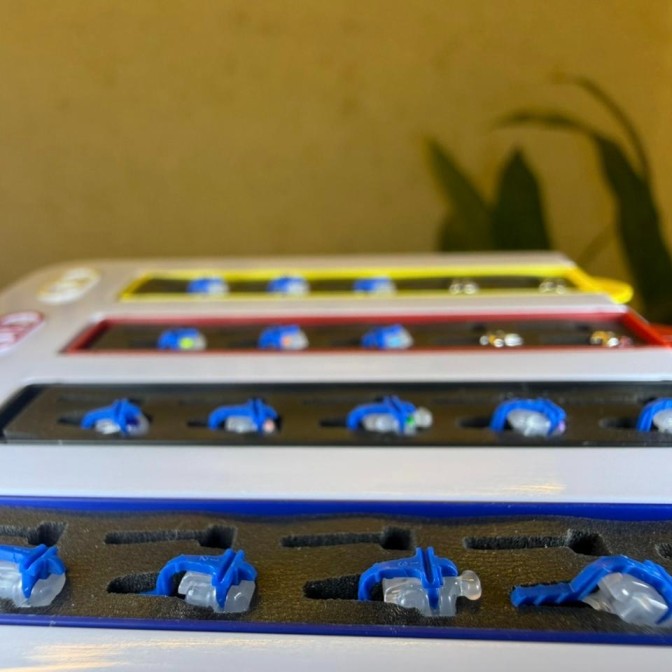
Self-ligating braces hold the wire with a small built-in clip instead of elastic ties. That makes them neater, easier to clean and quicker to adjust. However, the research does not show that they straighten teeth much faster than regular braces. The type of bracket matters less than the plan behind it.
Many parents and adults now ask for self-ligating braces by name, often after seeing them online as “faster” or “painless” braces. So here is what they are, what they really do better, and how we decide which braces suit you.
What are self-ligating braces?
Every set of braces has the same three parts: brackets glued to the teeth, a wire that runs through them, and something that holds the wire in each bracket.
With regular (conventional) braces, that last part is a tiny elastic ring, called a ligature, around each bracket. These are the coloured bands that children love to choose. We replace them at every adjustment visit.
With self-ligating braces, the bracket has its own small door or clip. It snaps shut over the wire, so there are no elastic rings at all. You may have heard brand names such as Damon. They are all variations of this idea.
Self-ligating brackets come in metal and in tooth-coloured ceramic, just like regular braces.
Are self-ligating braces faster?
This is the main claim, so it deserves an honest answer. Several systematic reviews have compared the two types, and they agree: overall treatment time is about the same. A large review in the American Journal of Orthodontics and Dentofacial Orthopedics found no significant difference in how long treatment took. A multi-centre trial in the UK reached the same conclusion.
What self-ligating braces do save is chair time. Opening a clip and changing a wire is quicker than removing and replacing twenty elastic rings. As a result, each adjustment visit can be a few minutes shorter.
So if someone promises that self-ligating braces will finish your treatment in half the time, be cautious. Your timeline depends mostly on how far your teeth need to move, your bite, your age, and how well you keep your appointments. Most braces treatments take somewhere between 12 and 24 months.
Do self-ligating braces hurt less?
Again, the evidence is mixed. Some patients do feel less pressure, because the wire can slide more freely in a clip than under a tight elastic. On the other hand, studies comparing pain levels have not found a consistent difference.
With any braces, the first two or three days after fitting, and after each adjustment, can feel sore. Soft food and the usual painkillers help. After that, most people stop noticing them.
What they genuinely do better
Even without the speed claims, self-ligating braces have real advantages:
- Easier cleaning. Elastic rings trap plaque and food. Without them, there are fewer places for bacteria to hide, which helps your gums.
- No stained bands. Clear elastic ties pick up colour from turmeric, tea and coffee. Self-ligating brackets have none to stain, which is useful with ceramic braces.
- Shorter visits. Wire changes are quick.
- Smooth, compact look. There are no bands sitting on top of the brackets.
Self-ligating vs regular braces at a glance
| Self-ligating braces | Regular braces | |
|---|---|---|
| How the wire is held | Built-in clip or door | Elastic ring on each bracket |
| Total treatment time | About the same | About the same |
| Adjustment visits | A little shorter | A little longer |
| Cleaning | Easier, fewer plaque traps | Elastic rings collect plaque |
| Colour options | Metal or ceramic | Metal or ceramic, plus coloured bands |
| Staining of ties | No ties to stain | Clear ties can discolour |
Who are self-ligating braces good for?
They suit most people who need fixed braces. In particular, they are a good choice if:
- you find it hard to keep your teeth clean around brackets;
- you want ceramic braces and would rather avoid stained clear bands;
- you have a busy schedule and prefer shorter visits.
Regular braces remain an excellent, proven option, and children often enjoy picking colours for their bands. Either way, the most important part is a careful treatment plan. For example, one of our patients, a 13-year-old with crowded teeth, was treated with self-ligating braces in Baner, and an 11-year-old needed his upper jaw widened before self-ligating braces.
What about ceramic and clear aligners?
If you mainly care about how braces look, you have three choices. Ceramic braces, regular or self-ligating, blend in with your teeth. Clear aligners such as Invisalign are removable and almost invisible, but you need to wear them 20–22 hours a day. Our guide to Invisalign vs braces compares them in detail, and this ceramic braces case shows an adult result.
Common questions
Will I still need rubber bands? Possibly. Self-ligating braces don’t need the small elastic rings, but many patients still wear separate elastics between the upper and lower teeth to correct the bite. Your orthodontist will tell you if you need them.
Do I need fewer appointments? Usually about the same number, but each one may be shorter.
Can adults have self-ligating braces? Yes. Age is not a barrier as long as your gums and bone are healthy. Read more in braces for adults.
Will I still need a retainer? Yes. Every type of braces needs retainers afterwards, because teeth tend to drift back. See how long to wear retainers.
Book a braces consultation
We will check your teeth and bite, explain whether regular or self-ligating braces (or aligners) suit you, and give you a realistic timeline.
House of Tooth, Lane No. 4, behind Balewadi High Street, Baner, Pune 411045. Open Monday to Saturday 10 am – 8 pm, Sunday 10 am – 7 pm. Call or WhatsApp +91 70196 02137, or book online. See all our braces and aligner options.
About the author. Dr. Bhakti Halapanavar is a gold-medalist orthodontist, BDS, MDS (Orthodontics & Dentofacial Orthopedics) and an Invisalign-certified provider at House of Tooth in Baner, Pune.